Abberior Instruments
the inventor and developer of STED Superresolution
STEDYCON 2 @ work
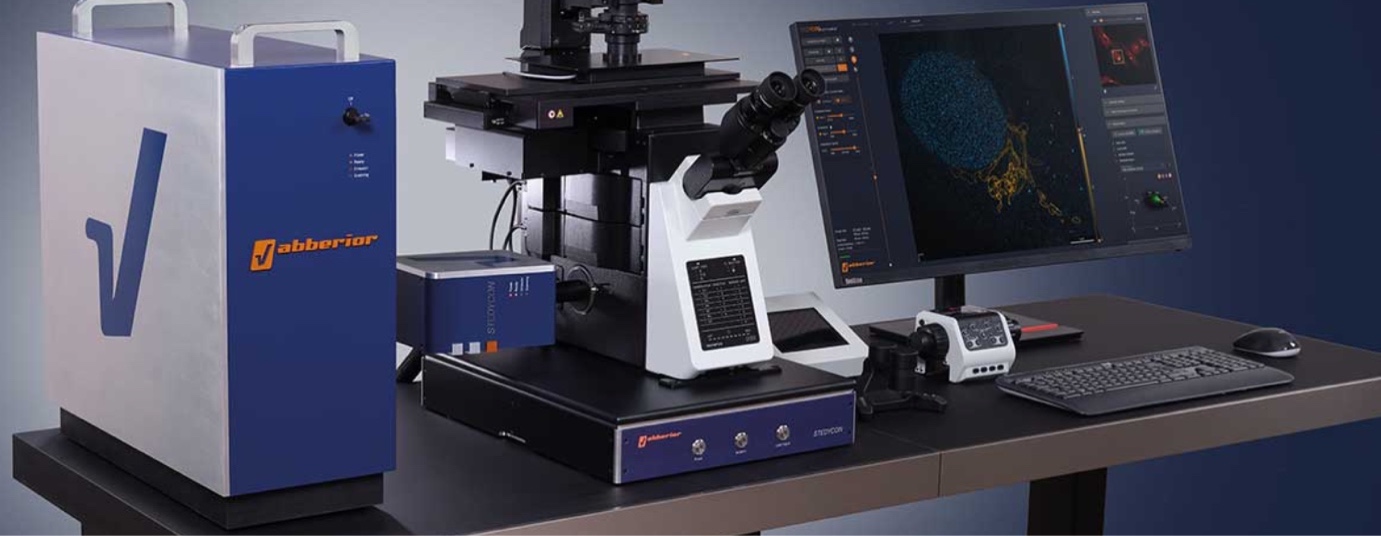
The new STEDYCON 2.0 has been launched! STEDYCON 2.0 contains confocal, STED and lifetime imaging in one system, makes imaging simple, more powerful, and flexible.
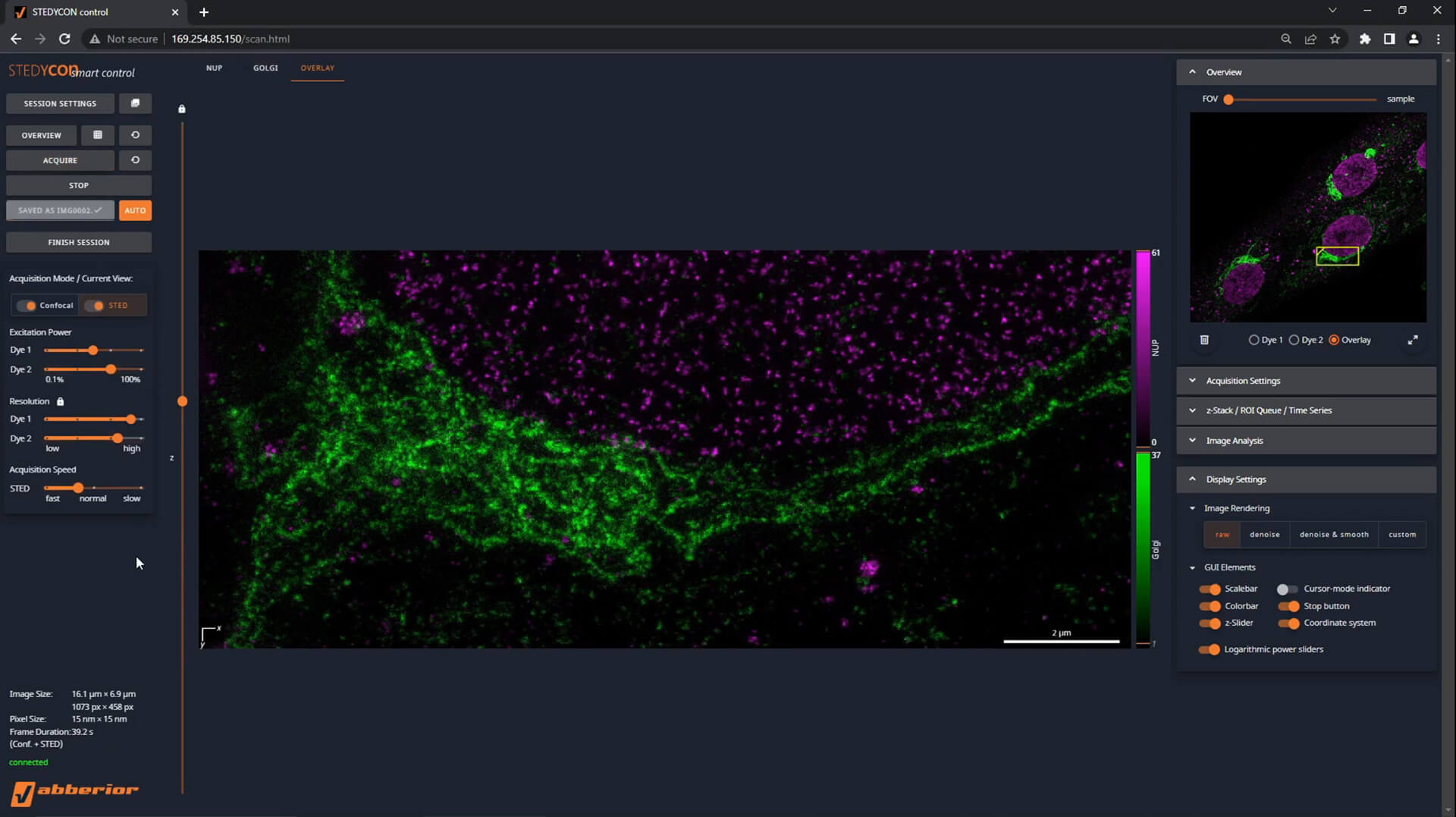
Just a few clicks, one can collect high-quality STED images, by using the STEDYCON smart control software.
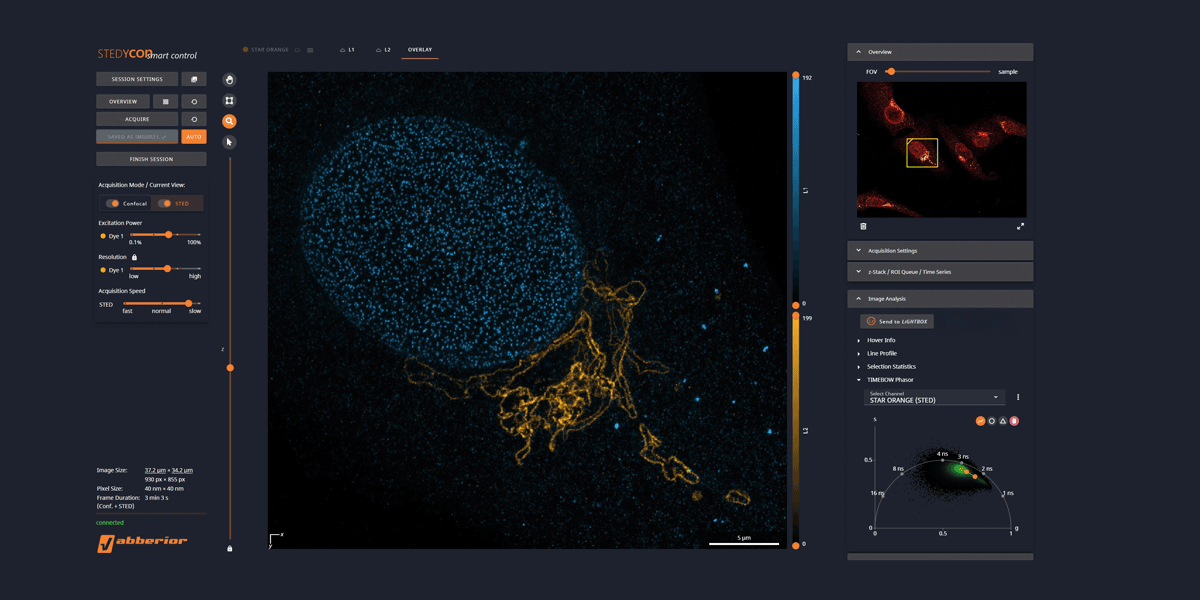
With TIMEBOW, STEDYCON 2 can give time a color too!
MIRAVA Polyscope one for all and all for one: the perfect image
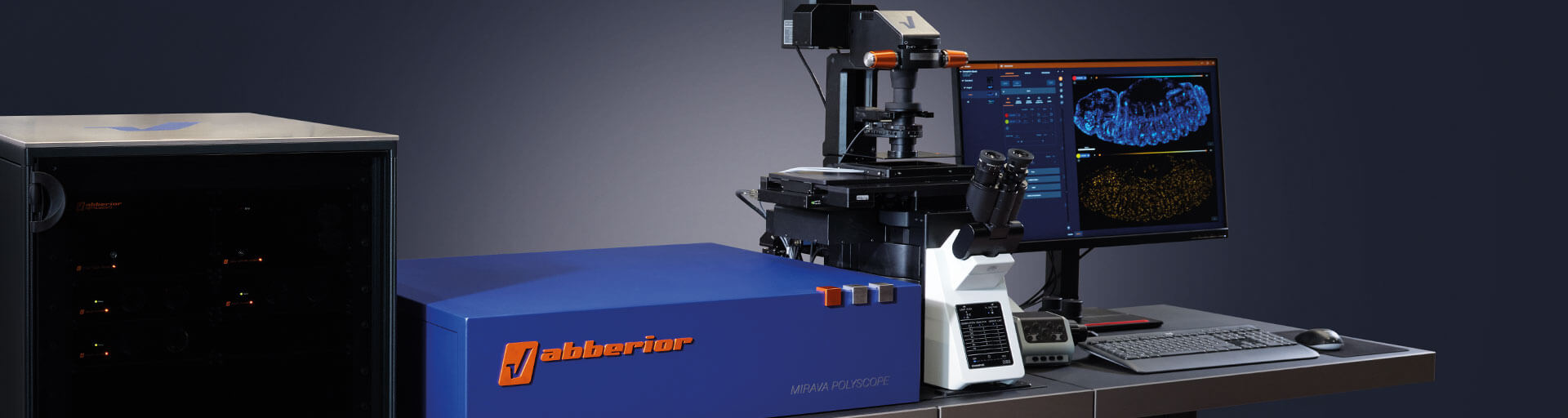
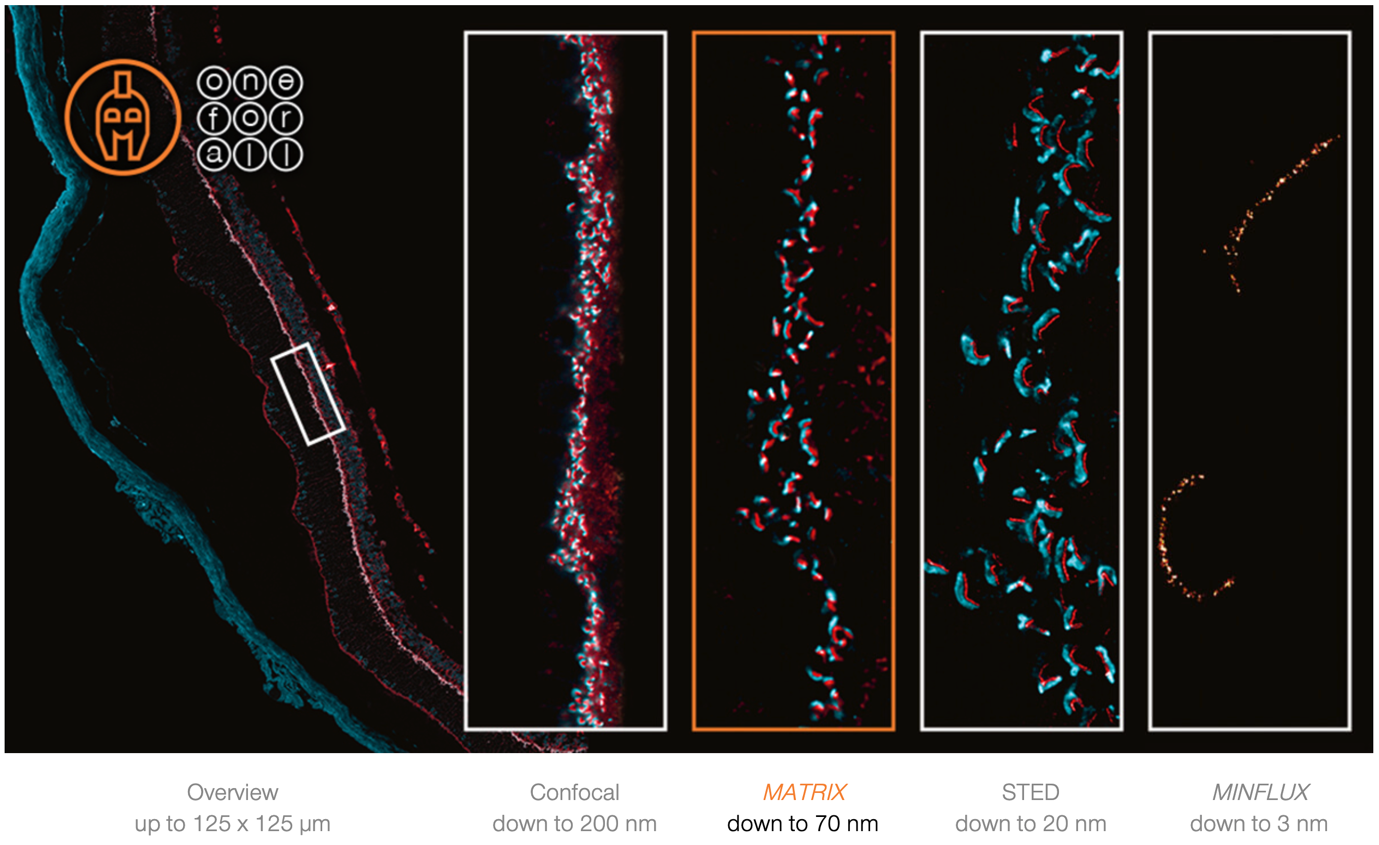
abberior’s MIRAVA POLYSCOPE unites four microscopy technologies to cover an unprecedented resolution spectrum, extending over several orders of magnitude from diffraction-limited imaging all the way to true molecular resolution.
MIRAVA POLYSCOPE is the world’s only all-in-one solution for confocal, MATRIX, STED and MINFLUX microscopy with resolutions from millimeters down to 3nm.
Confocal imaging with resolution down to 200nm
MATRIX (+Truesharp deconvolution) imaging with resolution down to 70nm
STED with resolution down to 20nm
MIMFLUX with resolution down to 200nm
Focus on your research, we take care of the rest
Sample courtesy: Arlene Hirano, PhD, University of California Los Angeles, Los Angeles, CA, USA (confocal, MATRIX, STED), and Dr. Chad Grabner and Prof. Dr. Tobias Moser, Max Planck Institute for Multidisciplinary Sciences, Göttingen, Germany (MINFLUX).
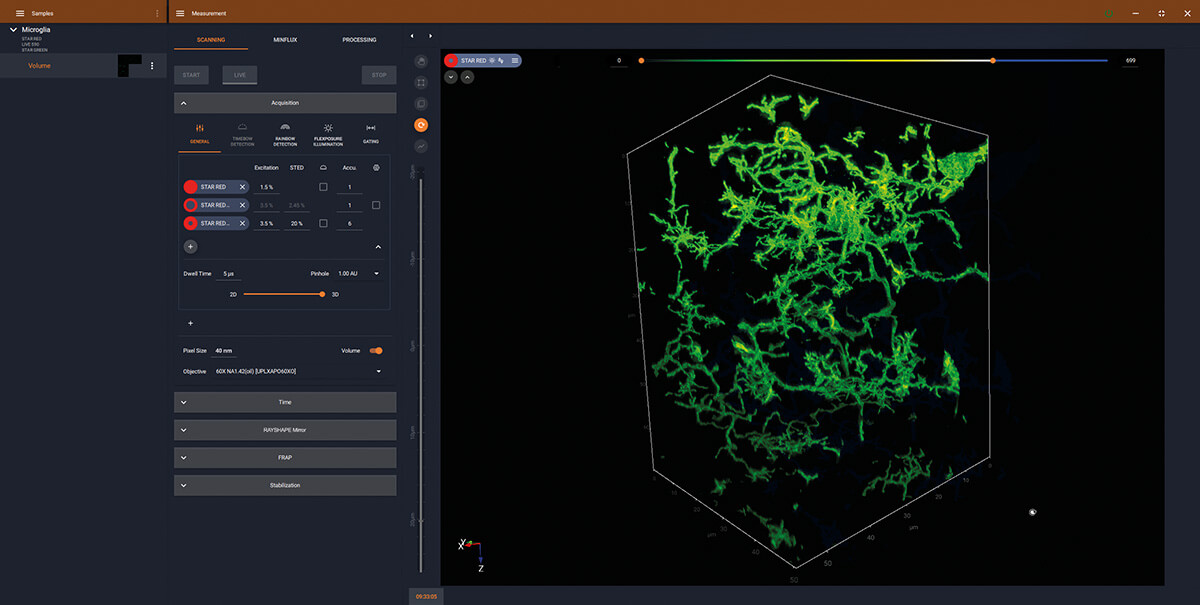
LiGHTBOX software, it’s all about ease of use
abberior’s LiGHTBOX ensures that even the most advanced imaging technologies are accessible to all users, regardless of their experience. All major settings are just one click away, and the intuitive software design facilitates quick learning, while it grants experts full control over all aspects of their measurement. You can even automate image acquisition and analysis by running Python scripts.
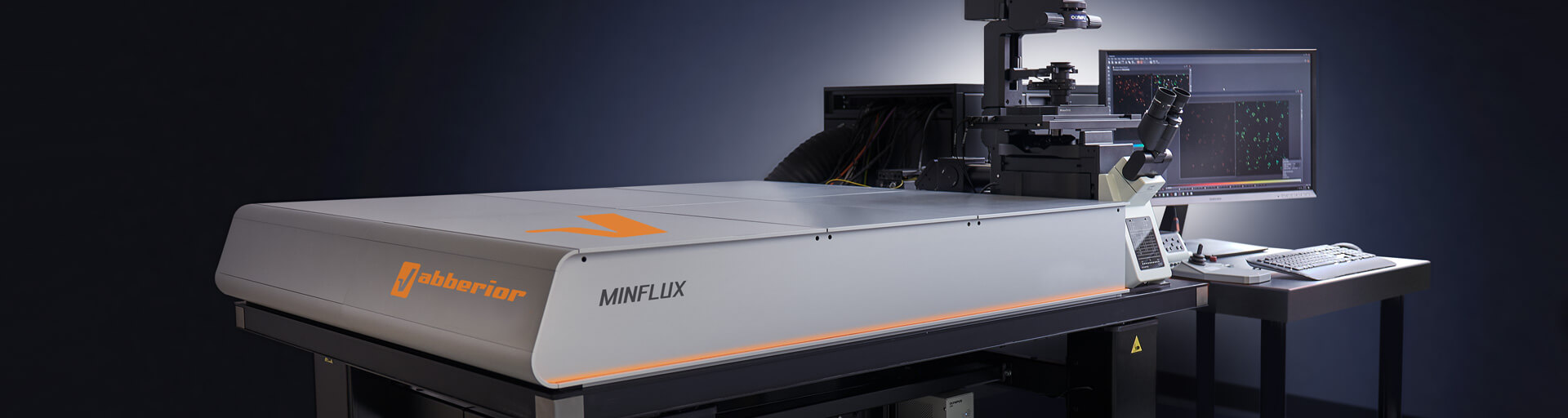
MINFLUX 3D Unrivaled resolution and speed
The MINFLUX platform offers an unprecedented array of imaging possibilities and allows you to resolve structures as small as a molecule, along all three dimensions. This unmatched resolution capability combined with unprecedented speeds reveals sample details never seen before. The MINFLUX is the world’s most powerful fluorescence microscope.
100x sharper than a confocal microscope
MINFLUX is the most precise and most photon-efficient way of localizing fluorescent molecules. With its new MINFLUX system, abberior has produced the first commercial fluorescence microscope that can achieve localization precisions of 1-3 nm (3D) in biological samples on large fields of view (10 x 15 μm). MINFLUX imaging means getting the maximal localization information out of your sample.
100x faster than a camera
MINFLUX tracks molecular movements at frequencies up to 10 kHz, resolving molecular motion every 100 μs. That’s 100 times faster than conventional camera-based methods. Of course, tracking works in all three dimensions, i.e. along x, y, and z. Due to the low number of photons required for each localization, single molecules can be monitored with unprecedented spatio-temporal resolution (e.g. 28.000 localizations each at 20 nm resolution).
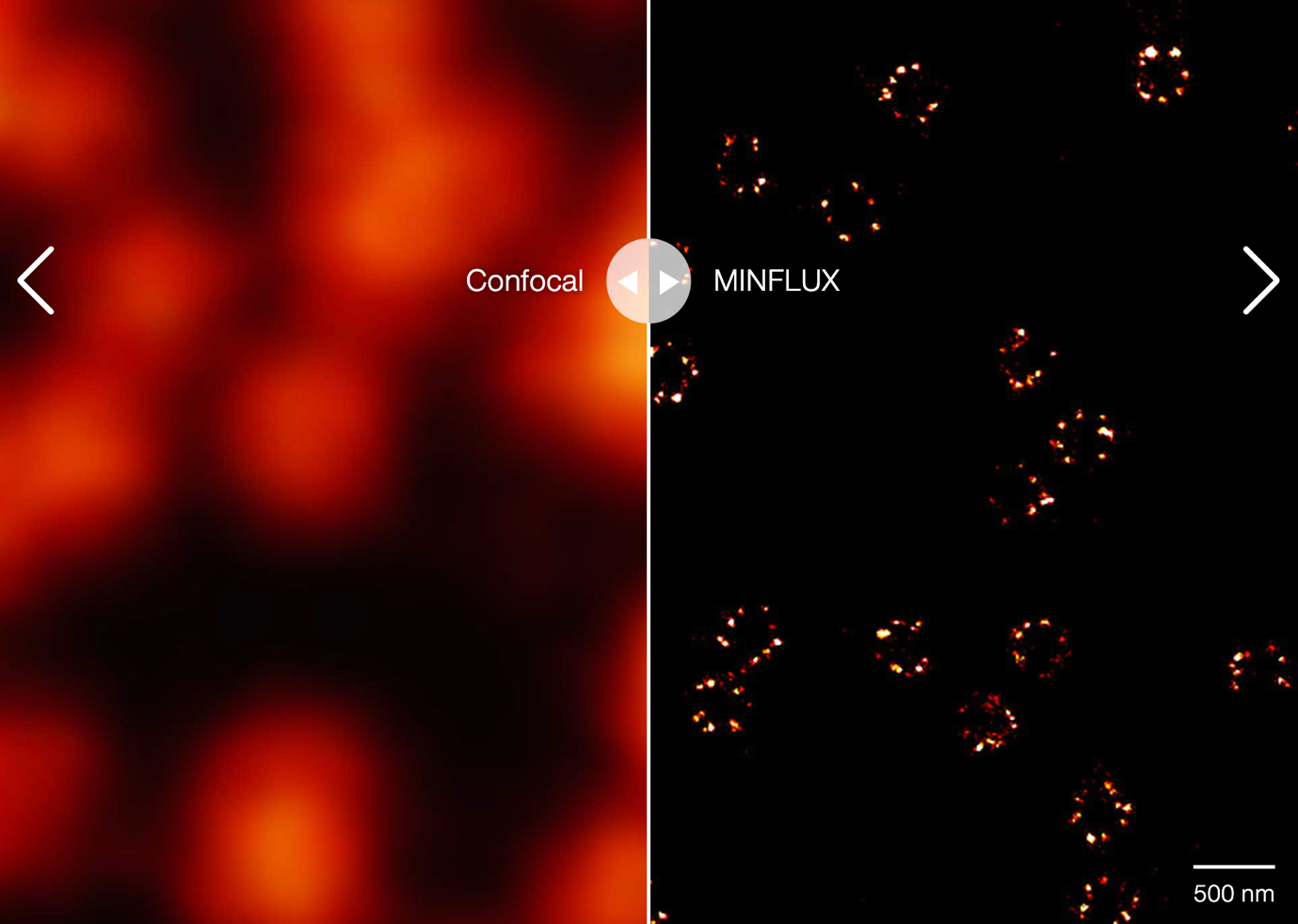
2D MINFLUX nanoscopy of the nuclear pore complex subunits. NUP96-SNAP/SNAP-Alexa Fluor 647 lend themselves as benchmark structures to test superresolution light microscopes. In contrast to confocal microscopy, 2D MINFLUX allows to visualize the shape and arrangement of individual subunits of the nuclear pore complex. Here, we reach localization precisions of ~2 nm in raw localization data.
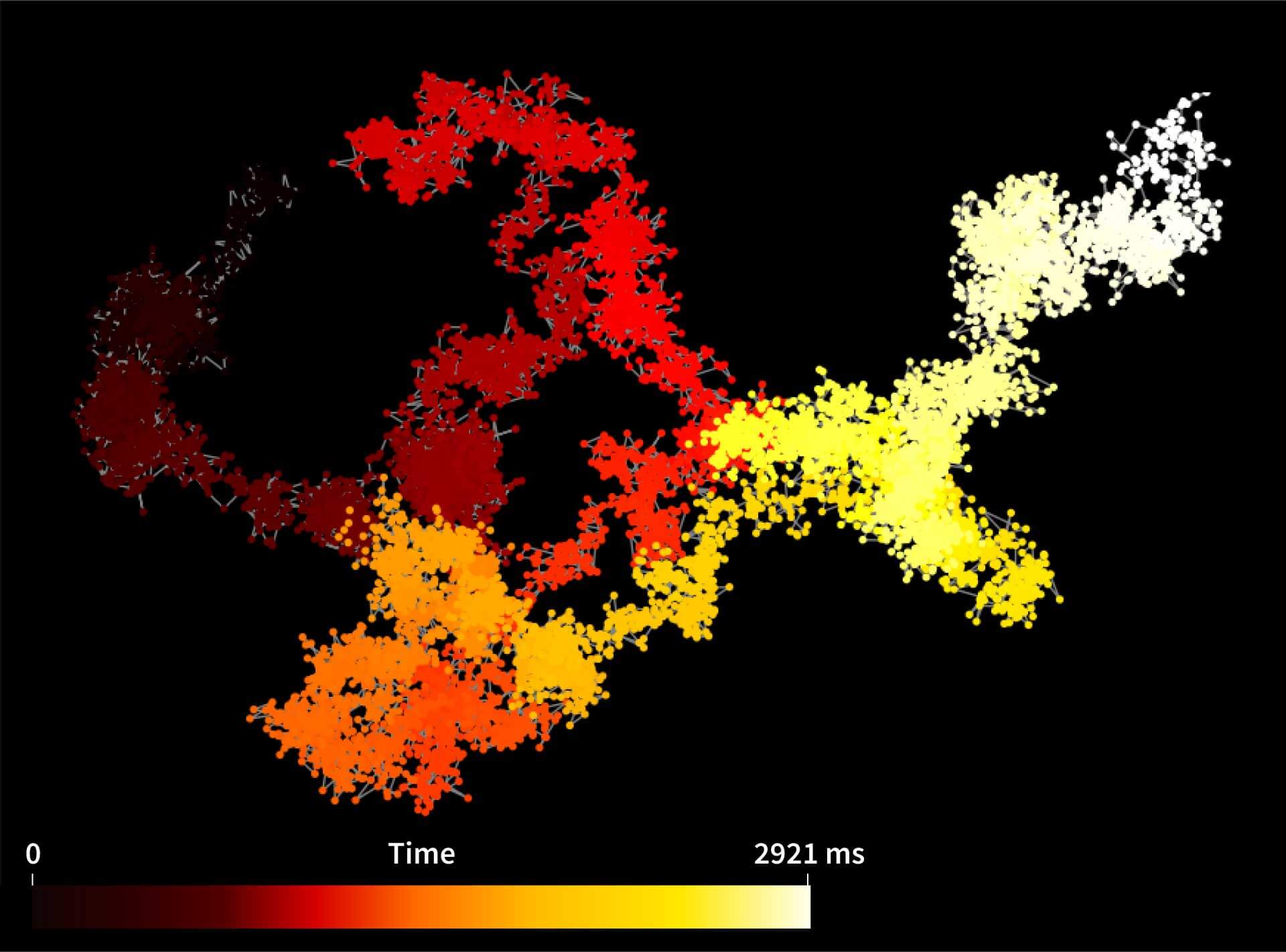
2D tracking of a lipid-coupled Atto 647N molecule embedded in a supported lipid bilayer. The movement of the labeled lipid was tracked with a frequency of up to 10 kHz.
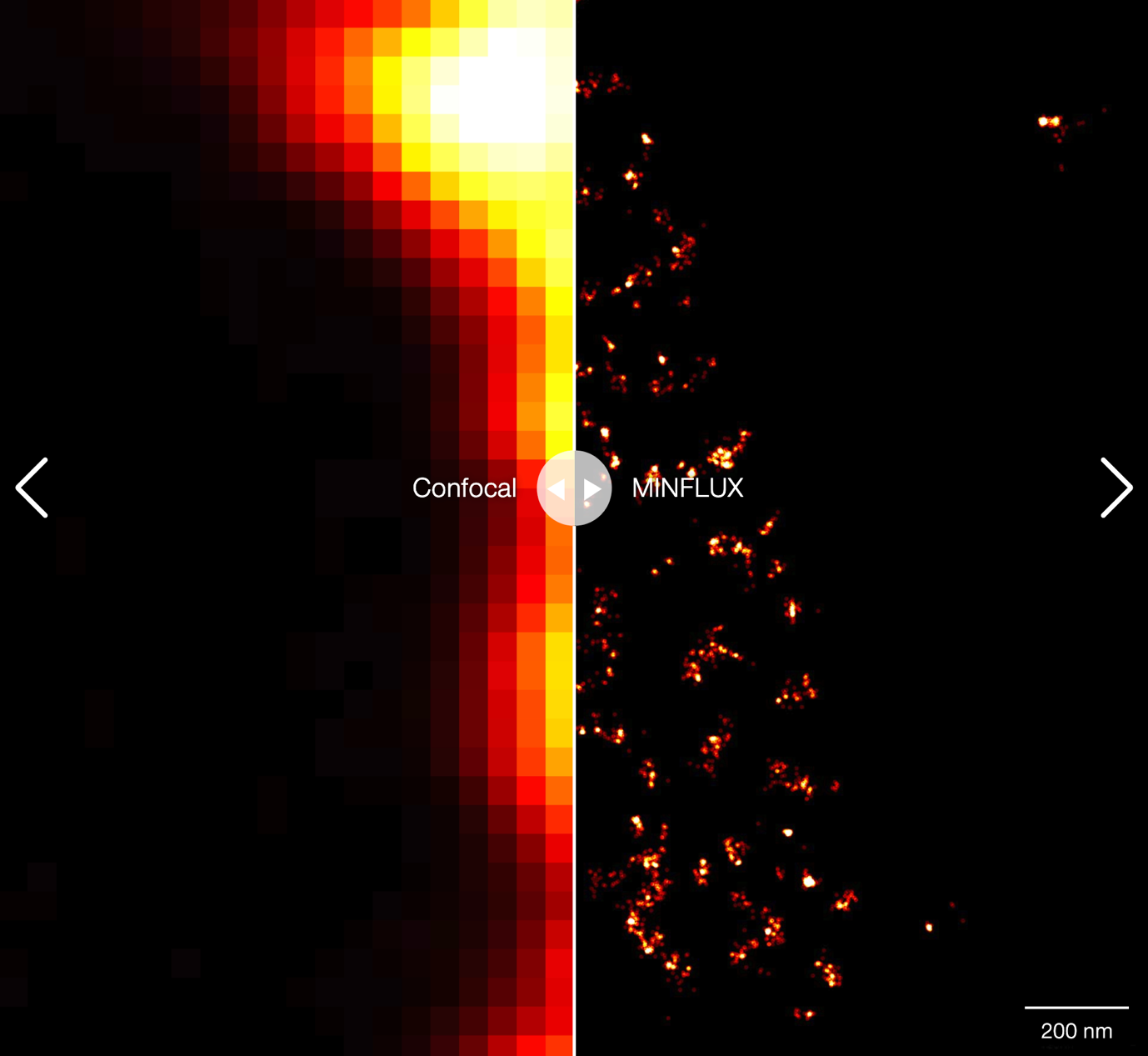
MINFLUX image of axonal bII spectrin in primary hippocampal neurons with < 2 nm resolution. Note the periodic arrangement of spectrin along the axon, and the absence of any details in the confocal counterpart image.
Would like to obtain more info and learn more of its applications?
Abberior Instruments
the inventor and developer of STED Superresolution
STEDYCON 2 @ work
The new STEDYCON 2.0 has been launched! STEDYCON 2.0 contains confocal, STED and lifetime imaging in one system, makes imaging simple, more powerful, and flexible.
Just a few clicks, one can collect high-quality STED images, by using the STEDYCON smart control software.
With TIMEBOW, STEDYCON 2 can give time a color too!
MIRAVA Polyscope one for all and all for one: the perfect image
abberior’s MIRAVA POLYSCOPE unites four microscopy technologies to cover an unprecedented resolution spectrum, extending over several orders of magnitude from diffraction-limited imaging all the way to true molecular resolution.
MIRAVA POLYSCOPE is the world’s only all-in-one solution for confocal, MATRIX, STED and MINFLUX microscopy with resolutions from millimeters down to 3nm.
Confocal imaging with resolution down to 200nm
MATRIX (+Truesharp deconvolution) imaging with resolution down to 70nm
STED with resolution down to 20nm
MIMFLUX with resolution down to 200nm
Focus on your research, we take care of the rest
Sample courtesy: Arlene Hirano, PhD, University of California Los Angeles, Los Angeles, CA, USA (confocal, MATRIX, STED), and Dr. Chad Grabner and Prof. Dr. Tobias Moser, Max Planck Institute for Multidisciplinary Sciences, Göttingen, Germany (MINFLUX).
LiGHTBOX software, it’s all about ease of use
abberior’s LiGHTBOX ensures that even the most advanced imaging technologies are accessible to all users, regardless of their experience. All major settings are just one click away, and the intuitive software design facilitates quick learning, while it grants experts full control over all aspects of their measurement. You can even automate image acquisition and analysis by running Python scripts.
MINFLUX 3D Unrivaled resolution and speed
The MINFLUX platform offers an unprecedented array of imaging possibilities and allows you to resolve structures as small as a molecule, along all three dimensions. This unmatched resolution capability combined with unprecedented speeds reveals sample details never seen before. The MINFLUX is the world’s most powerful fluorescence microscope.
100x sharper than a confocal microscope
MINFLUX is the most precise and most photon-efficient way of localizing fluorescent molecules. With its new MINFLUX system, abberior has produced the first commercial fluorescence microscope that can achieve localization precisions of 1-3 nm (3D) in biological samples on large fields of view (10 x 15 μm). MINFLUX imaging means getting the maximal localization information out of your sample.
100x faster than a camera
MINFLUX tracks molecular movements at frequencies up to 10 kHz, resolving molecular motion every 100 μs. That’s 100 times faster than conventional camera-based methods. Of course, tracking works in all three dimensions, i.e. along x, y, and z. Due to the low number of photons required for each localization, single molecules can be monitored with unprecedented spatio-temporal resolution (e.g. 28.000 localizations each at 20 nm resolution).
2D MINFLUX nanoscopy of the nuclear pore complex subunits. NUP96-SNAP/SNAP-Alexa Fluor 647 lend themselves as benchmark structures to test superresolution light microscopes. In contrast to confocal microscopy, 2D MINFLUX allows to visualize the shape and arrangement of individual subunits of the nuclear pore complex. Here, we reach localization precisions of ~2 nm in raw localization data.
2D tracking of a lipid-coupled Atto 647N molecule embedded in a supported lipid bilayer. The movement of the labeled lipid was tracked with a frequency of up to 10 kHz.
MINFLUX image of axonal bII spectrin in primary hippocampal neurons with < 2 nm resolution. Note the periodic arrangement of spectrin along the axon, and the absence of any details in the confocal counterpart image.
Would like to obtain more info and learn more of its applications?